
Reviewed · ST ANDREWS & FIFE TOURS
St Andrews History Tours
St Andrews has more stories than golf. This 90-minute walk with historian Richard Falconer moves beyond fairways to cathedral ruins, university courtyards, old pilgrim routes, fishing-town corners, and tales of ghosts and lost treasure. I like the way the tour reaches places many people skip, especially St Andrews Harbour and the historic quarters of the university. I also like that it is a private activity, so your group can ask questions and set the pace within the scheduled route.
The main caution is physical. This is a walking tour for people with moderate fitness, and it is not suited to anyone who needs to walk slowly. The tour also requires good English, and poor weather can lead to a cancellation or a change of date.
In This Review
- Six things to know before you book
- Why this St Andrews walk is worth your afternoon
- Starting at St Mary’s College in 1538
- St Leonards School and a royal connection
- Walking through The Pends and the old pilgrim route
- The harbour most quick visits miss
- Thirty minutes with St Andrews Cathedral
- St Andrews Castle and the road to the Reformation
- The historic quarters of the University of St Andrews
- Richard Falconer’s guiding style
- Timing, meeting point, and walking demands
- Is $20.59 good value?
- Who should book this walk?
- Should you book St Andrews History Tours?
- FAQ
- How long does St Andrews History Tours last?
- What time does the tour start?
- Where does the tour begin?
- Where does the tour finish?
- Is this a private tour?
- Who guides the tour?
- Is the tour suitable for children?
- Can I cancel for a full refund?
Six things to know before you book
- The cathedral gets 30 minutes: That is enough time for its major story, including the long search for its lost treasure.
- Richard Falconer leads the walk: His enthusiastic, specialist approach is a major part of the experience.
- The route reaches seven historic stops: You see the university, harbour, castle, cathedral, old city entrance, and two important schools.
- It is a private tour: Your own group takes part, rather than joining a large public crowd.
- The walk starts at 2 p.m.: The meeting point is The Bothy in Church Square, with the finish near Central Bar on College Street.
- The price is $20.59 per person: For a 90-minute private history walk, that is a strong deal, especially if you want context rather than a quick photo stop.
Why this St Andrews walk is worth your afternoon
St Andrews is easy to reduce to one subject: golf. That misses the point. The town was also a major religious center, an old fishing port, and home to Scotland’s oldest university. This tour gives you a useful frame for all three.
I like guided walks in places where the buildings are impressive but their stories are not obvious. St Andrews fits that bill. A ruined wall may look simple until you learn what it meant to medieval pilgrims. A college doorway may seem quiet until you hear why it was built. The guide’s role here is not just to point at stone. It is to connect the stone with power, religion, education, conflict, and local legends.
The tour also gives you a different view of famous people linked with the town, including Mary, Queen of Scots. The focus is not only on grand names. You also hear about the people who lived, studied, worshipped, and perhaps still haunt these old quarters.
At $20.59 per person, the value is easy to see. Admission is free at each listed stop, so you are paying for the guide’s research, storytelling, and ability to make sense of the town. If you walked the same streets alone, you could see the buildings, but you would miss much of the meaning.
More St Andrews and Fife trips:
- St Andrews Must-Sees Daily Walking Tour (11am & 2pm)
★ 5.0 · 478 reviews - St Andrews Old Course History Tour, for the Golfer
★ 4.5 · 150 reviews - St Andrews Tours: Town, Golf and Old Course History
★ 5.0 · 138 reviews
Starting at St Mary’s College in 1538
The walk begins at St Mary’s College, built in 1538 as the university’s third college. Its purpose was linked to the fight against heresy, which immediately gives the tour a more serious tone than a basic introduction to St Andrews.
This is described as a quieter place away from the main route. That matters because the town’s best-known buildings can draw most of the attention. At St Mary’s, you get a chance to consider how closely education and religion were linked in Scotland.
The stop lasts about five minutes and has no separate admission charge. Do not expect a long interior visit based on the information provided. Its value is the story and the setting, not a large block of free time.
St Leonards School and a royal connection
Next comes St Leonards School, a private school with a high standing in Scotland and beyond. The stop also connects the school with the Queen Mother, who attended primary school there.
This is a short five-minute pause, but it adds another layer to the town’s educational identity. St Andrews is not only an old university town. It also has institutions with long links to privilege, public life, and prominent families.
For you, the main benefit is context. The school helps show how education has shaped the town across different periods. It is also a useful reminder that St Andrews remains a living place, not simply an open-air collection of medieval remains.
Walking through The Pends and the old pilgrim route
The Pends marks the historic entrance used by pilgrims arriving at St Andrews. The route then follows an old thoroughfare through the former priory precincts.
This is one of the most atmospheric parts of the walk because the path itself carries the story. You are not just hearing about pilgrims in an abstract way. You are following the route that brought them into the city.
The stop takes about ten minutes. I would pay close attention here, since this is the kind of detail that is easy to miss without a guide. On your own, The Pends might register as an attractive old entrance. With Richard’s explanation, it becomes part of the town’s religious and civic history.
The route also helps you understand how the cathedral area once functioned. Buildings and streets were not placed at random. They served a large religious center that drew people from far beyond Fife.
More history walks:
- Old Town Walking Tour History and Tales in Edinburgh
★ 5.0 · 2,168 reviews - Old Town Historical and Underground Tour
★ 5.0 · 1,574 reviews - Multi-Sensory Small-Group Historic Vaults Tour in Edinburgh
★ 4.5 · 1,384 reviews - Edinburgh Old Town: Historical Guided Walking Tour
★ 5.0 · 1,016 reviews
The harbour most quick visits miss
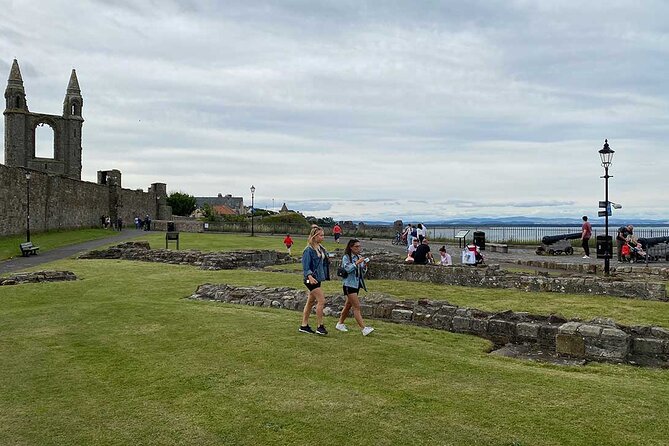
The walk then turns toward St Andrews Harbour, with about ten minutes set aside for the area. This is a smart inclusion. Many people come for the cathedral, castle, university, or golf and never spend much time by the water.
The harbour gives you a look at St Andrews as an old fishing town. It also offers a change of mood after the formal college and religious sites. Here, the story is tied more closely to work, trade, boats, and the town’s relationship with the coast.
The supplied details describe the harbour as an area of great beauty that many people miss. That is a useful clue for planning your day. If you have already seen the cathedral and castle before the tour begins, the harbour may be one of the route’s freshest discoveries.
Do remember that this is still a walking stop, not a long scenic break. The tour covers seven locations in roughly 90 minutes, so the pace has to keep moving.
Thirty minutes with St Andrews Cathedral
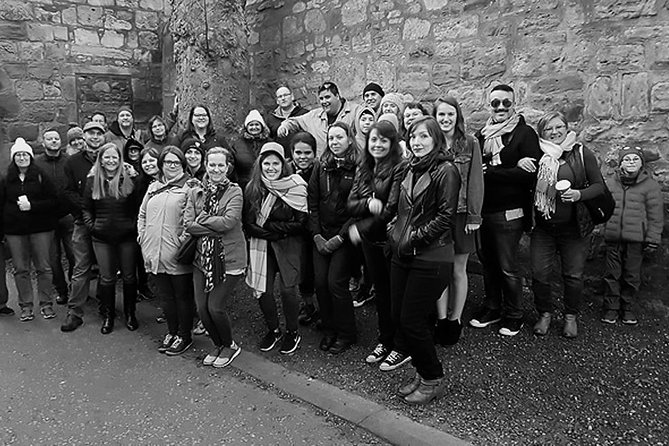
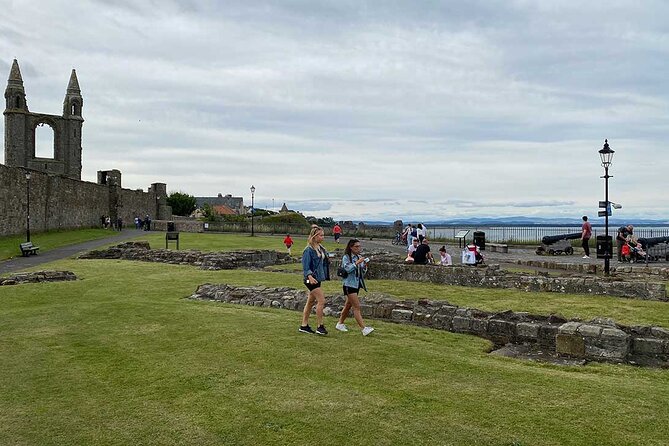
The longest stop is St Andrews Cathedral, with about 30 minutes devoted to its story. That is the heart of the tour.
The cathedral was once the seat of the Catholic Church in Scotland. Its remains now require imagination, and a guide can supply the missing scale and purpose. Richard’s account focuses on the cathedral’s role, its dramatic past, and the search for a lost treasure that occupied the town and university for 50 years.
That treasure story gives the stop a strong human edge. It is not only about bishops, church politics, and stonework. It is also about persistence, curiosity, and the belief that something valuable may still be waiting to be found.
The cathedral section is likely to appeal most to anyone who enjoys unresolved stories. You get a clear historical subject, a long-running search, and a physical setting that makes the tale easier to picture.
There is no separate admission charge listed for this stop. Still, you should not confuse free entry with a simple experience. The cathedral’s importance comes from the explanation. Without it, you may see ruins. With it, you get a better sense of why this was once such a powerful center.
St Andrews Castle and the road to the Reformation
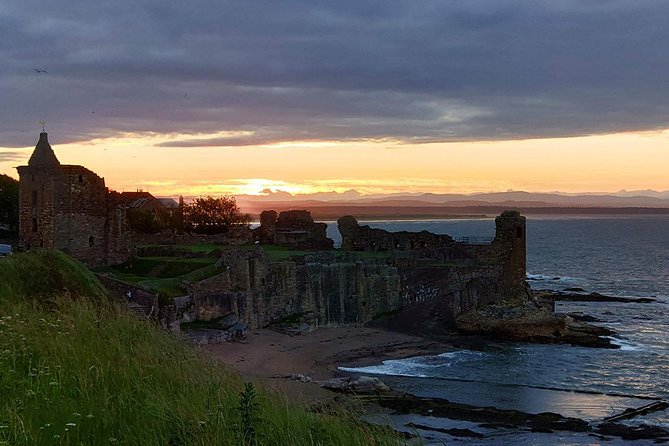
The next stop is St Andrews Castle, once the bishop’s palace from the 13th century. Only about five minutes are allocated here, so this is an overview rather than a full castle visit.
The story begins with a place of spiritual peace but ends in the Scottish Reformation. That change captures one of the tour’s main themes: St Andrews was shaped by religious authority, then shaken by conflict and reform.
The short timing is the one limitation. If you want a detailed examination of the castle’s defenses, prison, tunnels, or every stage of its history, you would need more time elsewhere. On this walk, the castle works as a concise chapter in the larger story.
That can be an advantage during a short visit. You get the castle’s role without losing the route’s wider focus on the whole town.
The historic quarters of the University of St Andrews
The tour finishes with about 30 minutes around the University of St Andrews, Scotland’s oldest university. This is another major part of the walk, and it should appeal to anyone who enjoys old academic buildings and the stories attached to them.
Rather than treating the university as one landmark, the route explores its historic quarters around the town. The architecture and layout help explain how the university became part of everyday St Andrews.
The university section also balances the cathedral story. The cathedral represents religious authority and medieval pilgrimage. The university shows how St Andrews continued to matter as a center of learning.
The guide’s approach seems especially useful here because the university is spread through the town rather than contained in one obvious attraction. You may pass several historic buildings without knowing which details matter. Richard’s explanations help you read the setting.
This is also the point where questions can add real value. The strongest comments about Richard focus on his ability to answer questions, connect history with current events, and adjust to the interests of the group. Since the tour is private, you have a better chance to ask about the subjects that catch your attention.
Richard Falconer’s guiding style
Richard is the key reason to choose this experience over a self-guided walk. The strongest praise centers on his enthusiasm, detailed research, and ability to bring the town’s past to life.
You can expect stories about famous residents and visitors, local legends, ghosts, the cathedral, the university, and the lost treasure. The tone is not limited to formal dates. It includes obscure details and unusual corners, which helps the town feel less predictable.
Several comments describe Richard as friendly and willing to answer questions. One useful detail is that people who took both the history tour and the ghost tour found that the two experiences added to each other. That suggests this history walk can work well as the more factual part of a broader St Andrews visit.
The guide is also praised for adapting to the group. That matters on a private walk. You are not simply listening to a fixed speech while trying to keep up with a crowd. You have a chance to make the tour more relevant to your own interests.
Still, the tour requires you to understand English well. That is not a minor point, since the guide’s storytelling is the main product. If you miss spoken detail, much of the value will be lost.
Timing, meeting point, and walking demands
The tour starts at 2 p.m. outside The Bothy St Andrews, at 3 Church Square, St Andrews KY16 9NN. It ends at 75 Market Street, with the final point beside Central Bar at the top of College Street.
The advertised duration is about one hour and 30 minutes. That makes it easy to fit into a day trip, particularly if you arrive in St Andrews earlier and want time to explore independently before or after the walk.
One direct comment describes taking the morning train from Edinburgh and spending the afternoon in St Andrews, including this tour. The walk therefore fits well into a longer day in town, though the supplied information does not give train times or transport directions.
You should wear sensible walking shoes and be prepared for a steady route through historic streets and outdoor sites. A moderate fitness level is required, and the tour is not suitable for people who need to walk slowly. The information also says the experience is not suitable for children under two, while children under five go free.
Service animals are allowed, and the starting area is near public transportation. Since the tour depends on good weather, bring clothing that suits Scotland’s changeable conditions. If poor weather causes a cancellation, you are offered another date or a full refund.
Is $20.59 good value?
For $20.59 per person, this is good value if you want a guided introduction rather than a paid entry ticket. The route covers seven important parts of St Andrews, and the guide adds the background that free public sites often lack.
The private format improves the value further for families or small groups. You can ask questions, hear the stories clearly, and spend attention on the subjects that interest you most.
The price is less compelling if you want extended time inside each site. The castle gets only five minutes, and the cathedral and university receive the largest portions of the walk. Think of this as a town overview with strong historical storytelling, not a full architectural inspection of every building.
At 90 minutes, the length is well judged. One comment specifically praised the duration as perfect, while another wished for more time with Richard. That tells you what to expect: the tour is long enough to feel worthwhile, but short enough to fit into a busy day. You may finish wanting more, especially if the cathedral or university captures your attention.
Who should book this walk?
I would recommend it to you if you want:
- A first look at St Andrews beyond golf
- A private walking experience with plenty of chances for questions
- Local stories about Mary, Queen of Scots, ghosts, and the cathedral treasure
- A guide who can connect separate buildings into one clear story
- A compact tour that fits a day trip from Edinburgh or another base
- A mix of major landmarks and less obvious places such as the harbour
It may not suit you if you have difficulty walking, need a slow pace, or prefer a tour conducted in a language other than English. It is also not the best choice if your main goal is a long, detailed visit inside the castle or cathedral.
Should you book St Andrews History Tours?
Book it if you want the town to make sense. The cathedral, castle, harbour, schools, and university are much more rewarding when you understand how they connect.
Richard Falconer’s enthusiasm is the strongest reason to choose this walk. The lost treasure story, the old pilgrim route, and the university’s historic quarters give it more character than a standard sightseeing circuit. At $20.59, the price is modest for a private 90-minute introduction.
I would book it early in your St Andrews day, then use the rest of your time to return to the places that deserve a slower look. Just allow for outdoor walking, bring weather-ready clothing, and make sure the pace suits your group.
FAQ
How long does St Andrews History Tours last?
The tour lasts approximately one hour and 30 minutes.
What time does the tour start?
The tour starts at 2 p.m.
Where does the tour begin?
The meeting point is The Bothy St Andrews, 3 Church Square, St Andrews KY16 9NN, UK.
Where does the tour finish?
The tour finishes at 75 Market Street, St Andrews KY16 9NU, beside Central Bar at the top of College Street by Market Street.
Is this a private tour?
Yes. Only your group participates in the activity.
Who guides the tour?
The tour is led by historian Richard Falconer.
Is the tour suitable for children?
Children under five can join free. The tour is not suitable for children under two.
Can I cancel for a full refund?
Yes. You can cancel at least 24 hours before the experience start time for a full refund. Cancellations or changes made less than 24 hours before the start time are not refunded, and poor weather may lead to a new date or full refund.
Just added around St Andrews
- St. Andrews Scenic Stroll: A Private Walking Exploration★ 5.0 · 6 reviews
- The Original St Andrews Photo Shoot Tour★ 5.0 · 7 reviews
- A Wee Walk and a Cocktail in St. Andrews★ 4.0 · 7 reviews
- St Andrews Walking Tours★ 5.0 · 8 reviews
- Barrel-top whisky tasting in St Andrews★ 5.0 · 20 reviews
- Bespoke Private Tours of Scotland and the Borders★ 5.0 · 29 reviews
- Private St. Andrews Tour with Dedicated Local Guide★ 5.0 · 38 reviews
- Watch Building Experience – St Andrews★ 5.0 · 40 reviews
St Andrews & Fife Tours, compared.

St Andrews & the Fishing Villages of Fife Small-Group Day Tour from Edinburgh
Read our review →
St Andrews Must-Sees Daily Walking Tour (11am & 2pm)
Read our review →

St Andrews & Cliffs and Dunnottar Castle in Spanish.
Read our review →
St Andrews Old Course History Tour, for the Golfer
Read our review →
St Andrews Tours: Town, Golf and Old Course History
Read our review →
Private St. Andrews: Home of Golf Old Course Walking Tour
Read our review →
Browse the lists this tour appears in