
Reviewed · HISTORICAL TOURS
The Magnificent and Mysterious History of Glasgow
Glasgow rewards curious walkers. This $17.91 history tour links grand civic buildings, medieval streets, murals, churches, and a pizza shop with the city’s stranger stories. I like the wide sweep of the route, and I like how guides such as Bruce and Henry Bell bring humor and local feeling to the facts. The main drawback is that the published timing and route details are not fully consistent, and some stops may be affected by construction or private events.
You begin near George Square and finish around Merchant City, with roughly 40 to 45 minutes of walking between sights. I especially like this as a first Glasgow activity because it gives you a useful map in your head before you explore alone. You should be ready for a brisk, talk-heavy walk, and a group of up to 15 people can make hearing difficult at times.
In This Review
- Six reasons this Glasgow walk is worth considering
- Starting with Glasgow’s grandest civic face
- Merchant power, mansions, and Glasgow’s public image
- Trades, markets, and the working city
- Art, religion, and Glasgow’s unusual sense of humor
- High Street and the city’s medieval core
- Finishing with Glasgow Cathedral and St Mungo
- What the guides do best
- Timing, group size, and route problems
- Is $17.91 good value?
- Who should take this Glasgow walking tour?
- Should you book it?
- FAQ
- How long does the tour last?
- Where does the tour start?
- Where does the tour finish?
- How much walking is involved?
- What language is the tour offered in?
- How many people can join the tour?
- Can I cancel for a full refund?
Six reasons this Glasgow walk is worth considering
- Glasgow’s story unfolds across 22 locations: You move from George Square and civic power to medieval High Street, Merchant City, and Glasgow Cathedral.
- The city’s eccentric side gets proper attention: The Duke of Wellington’s traffic cone, the Britannia Panopticon, a popular pizza restaurant, and a curious job offer all make the past feel less stiff.
- Guides are the heart of the experience: Bruce receives repeated praise for his humor, storytelling, local recommendations, and clear explanations. Henry Bell is also singled out for an engaging and entertaining presentation.
- You see the city’s artistic character: The route includes the Gallery of Modern Art, Trongate 103, Sharmanka Kinetic Gallery, and several Glasgow murals.
- The route packs in serious value: At less than $18, the tour includes around two to two and a quarter hours of guiding, with no separate admission charge listed for the stops.
- You need to allow extra time: The practical information gives a tour length of about 2 hours 45 minutes, while the headline duration says about 2 hours 4 minutes to 2 hours 14 minutes. One outing ran 30 minutes over.
Starting with Glasgow’s grandest civic face
Meet at George House, 50 George Square, beside one of Glasgow’s most impressive public spaces. The City Chambers is the first major sight, and it is a strong opening because the building says plenty about how 19th-century Glasgow wanted to present itself.
Look closely at the sculpture. The decoration is not simply there to make the building pretty. It reflects civic confidence, industrial wealth, and the way Glaswegians saw their city during a period of growth. Your guide uses the building to set up the larger story: Glasgow was not just a port or manufacturing center, but a city eager to show power and ambition.
The Glasgow War Memorial follows. It honors citizens killed in the First World War and uses symbolism to mark a major change in the city’s story. This is a short stop, but it gives the route a more serious tone after the grandeur of the City Chambers.
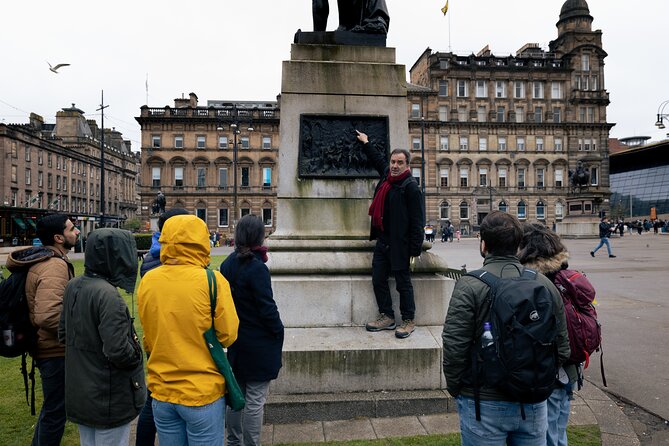
George Square also introduces two figures central to Scottish identity. The Sir Walter Scott statue is the square’s centerpiece, while the Robert Burns monument has its own democratic story. Thousands of people contributed as little as five pence to fund Burns’s sculpture, and 30,000 people attended the unveiling.
If your guide is Bruce, you may hear a Burns poem recited beside the statue. That kind of small performance is one reason the walk feels more personal than a simple list of dates and buildings.
More history walks:
- Glasgow: Pubs & History Walking Tour with Beer Tasting
★ 5.0 · 81 reviews - West of Scotland Cultural Tour
★ 5.0 · 7 reviews - Old Town Walking Tour History and Tales in Edinburgh
★ 5.0 · 2,168 reviews
Merchant power, mansions, and Glasgow’s public image
From George Square, the route moves toward the Merchant City. The Merchant’s House helps explain how Glasgow’s traders shaped the city’s prosperity and how they wanted to be remembered. You get a look at the social power behind the grand streets, not just the architecture itself.
The route then reaches the Gallery of Modern Art, once a private mansion. Its changing use gives your guide a chance to explain how buildings outlive their original owners and purposes. Glasgow often rewards this kind of reading. A grand façade may have begun as a private home, then become a public building, gallery, office, or event venue.
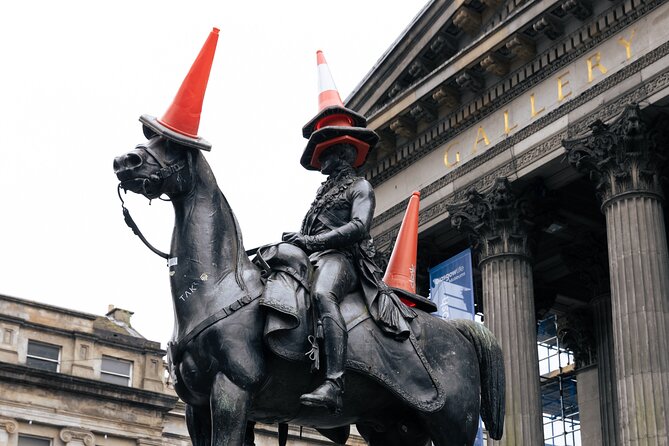
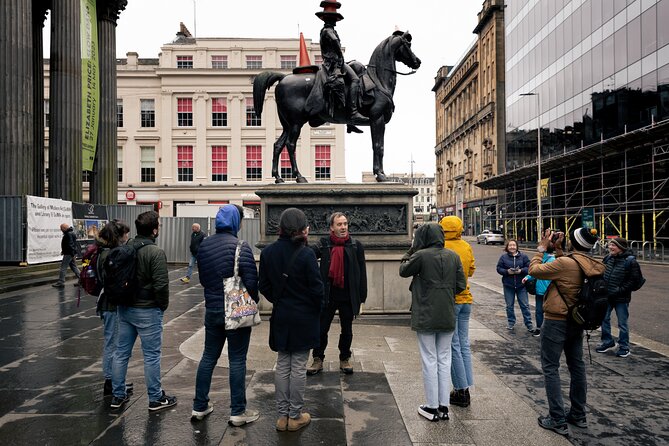
At the Duke of Wellington statue, the mood lightens. The Duke was a military leader and prime minister, but the statue is now famous for the traffic cone regularly placed on his head. It is one of Glasgow’s clearest examples of local humor and a mildly anti-authoritarian streak.
The brief stop at Paesano Pizza adds another modern note. It is one of the city’s popular pizza spots, but the point here is not lunch. The location is tied to a curious job opportunity from an earlier time, one of several odd details that give the tour its title.
The itinerary also refers to an 18th-century Georgian townhouse in modern Glasgow, connected to an original family with an interesting story. Since that stop is not clearly named in the supplied route, I would treat it as part of the Merchant City section rather than plan your visit around finding a particular entrance.
Trades, markets, and the working city
The Trades Hall of Glasgow shifts attention away from merchants and toward skilled workers. The Trades House represented groups such as carpenters, tanners, and dyers. It also supported members who became too old to work.
That detail matters. Glasgow’s story is not only about wealthy traders funding grand buildings. It also includes guilds and working associations that offered practical support before modern welfare systems existed. The stop is short, but it adds needed social balance.
Another unnamed stop focuses on a medieval street associated with candle makers. They worked apart from the old town because of the danger of fire. Later, the area became a place for markets and warehouses, and today it belongs to Glasgow’s cultural district.
This is one of the route’s better themes: the city keeps changing function without losing every trace of what came before. You walk through streets that once served practical trades, then see how they became part of the modern arts and shopping center.
The Corinthian Club occupies another building with several lives. It was once a bank, courthouse, and county building. Now it is a high-profile club and wedding venue. You may not go inside, but the exterior lets you consider how commercial and civic buildings are repeatedly adapted for new uses.
Art, religion, and Glasgow’s unusual sense of humor
The section around Ingram Street and Trongate brings together several of Glasgow’s strongest modern and historic attractions. The Saints of Ingram reference connects with the old Merchants House, the Trades House, and Hutchison’s Hospital, once described together as three important institutions serving Glasgow citizens.
The City Halls and Old Fruitmarket give you a glimpse of commercial Glasgow. The Old Fruitmarket was once a major trading place. The building remains, though its use has changed to retail and other public purposes. Your guide helps you picture the activity that once filled the space.
At Trongate 103, you reach a city arts center that includes the Sharmanka Kinetic Gallery. The route does not appear to include an admission visit, so think of this as an introduction rather than a museum tour. If the name catches your interest, make a note and return later with more time.
The Britannia Panopticon Music Hall is a particularly good stop for anyone interested in performance history. It is described as the world’s oldest surviving music hall, and a young Stan Laurel performed there before becoming one half of a famous comedy partnership.
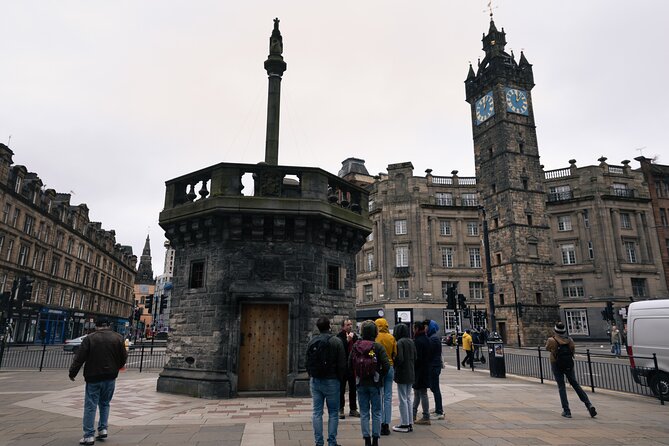
Mercat Cross adds another piece of old civic life. The recreated medieval market cross marks the sort of place where public announcements were made. It helps you picture a city in which news, trade, punishment, and ceremony all gathered in a public square.
A few more trips and experiences worth a look
- Guided Celtic Park Stadium Tour
★ 5.0 · 3,136 reviews - City Sightseeing Glasgow Hop-On Hop-Off Bus Tour
★ 4.5 · 1,873 reviews - Oban, Glencoe, Highlands Lochs & Castles Small Group Day Tour from Glasgow
★ 5.0 · 1,432 reviews - Glasgow City Centre Walking Tour with Local Guide
★ 5.0 · 1,326 reviews
High Street and the city’s medieval core
High Street is the longest stop on the route, at about 15 minutes, and rightly so. This was the heart of medieval Glasgow. Several major sights and stories gather along it, including the site of the old University, described as the fourth-oldest in Britain.
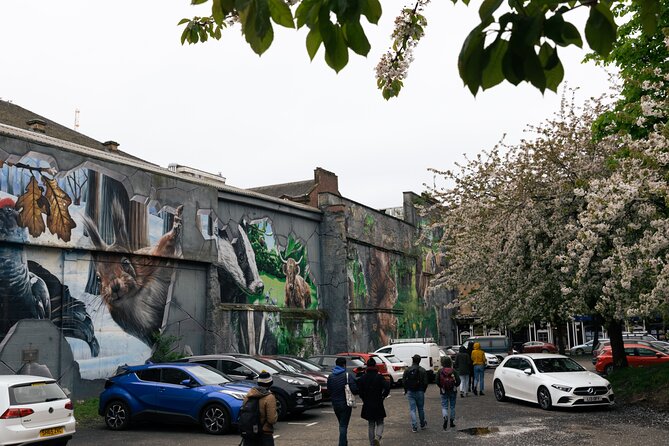
You also see two striking murals connected with St Mungo, Glasgow’s patron saint. These murals are an important part of the city’s modern public art, and they help connect the old religious story with the city you see today.
The David Livingstone statue recalls one of Scotland’s major explorers. It originally stood in George Square before being moved. That small fact says something about how Glasgow rearranges its public memory as streets and squares change.
The Ramshorn Theatre occupies a building opened in 1824, replacing an earlier church. Many prominent Glaswegians were buried there. In more recent years, it served as a theater and is now used for language studies by the University of Strathclyde.
This is where the route’s layers become especially clear. A church becomes a theater, then an educational center. A medieval street becomes a cultural district. A statue shifts location. Glasgow’s past is not sealed behind glass. It is folded into ordinary city life.
Finishing with Glasgow Cathedral and St Mungo
The final historic stretch includes the Friends of Glasgow Royal Infirmary Museum, Glasgow Cathedral, Provand’s Lordship, and the St Mungo Museum of Religious Life and Art.
The infirmary is Glasgow’s oldest hospital, and the brief stop points to medical innovations developed there. You should not expect a full museum visit in three minutes, but it adds a useful reminder that Glasgow’s history includes science and public health as well as trade, religion, and architecture.
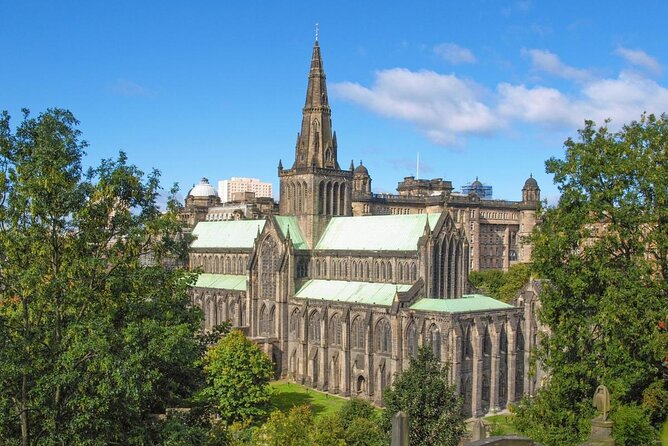
Glasgow Cathedral is the major finish point in the stated sightseeing sequence. The building dates from the 13th century, though a church has occupied the site since the 6th century. The 20-minute visit gives you the best chance to slow down and look properly.
Inside, pay attention to the sense of age and continuity. This is not simply another old church on a walking route. It is presented as Glasgow’s oldest building, and its connection with the city’s patron saint gives the earlier murals and religious stories more meaning.
Provand’s Lordship, dating from the 14th century, is one of Glasgow’s oldest buildings apart from the Cathedral. The St Mungo Museum was built to look much older than it is and presents religious life and art from many faiths around the world.
The route’s focus on St Mungo is one of its strongest threads. If you have not heard the story before, the guide’s explanation of his importance and miracles gives Glasgow a clearer identity. One participant specifically praised learning about Mungo and his place in the city’s story.
What the guides do best
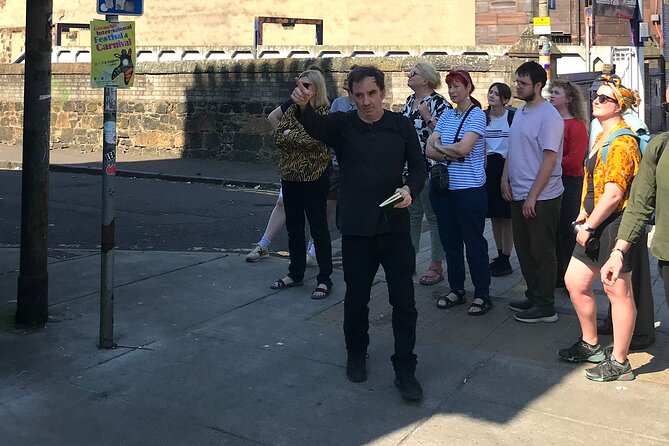
The strongest part of this experience is the guide. Bruce receives the most praise, with repeated comments about his humor, local knowledge, clear explanations, and ability to bring the city’s past to life. He is also credited with offering useful suggestions for places to visit after the walk.
Henry Bell is praised for speaking clearly and making the information entertaining. That matters on a walk with more than 20 stops. If the delivery is flat, the route becomes a tiring succession of statues. A good guide turns each stop into part of a larger story.
The tone seems direct rather than overly theatrical, although one person found the guide somewhat actor-like. Most of the feedback points to a comfortable but fairly quick pace. You cover a lot, so this is not the tour for someone who wants ten quiet minutes at every building.
One useful criticism deserves attention. A low-rated experience felt the tour was too focused on individual stops and did not always connect larger themes, such as religion, Glasgow’s arts scene, the city’s anti-establishment humor, and the financial effect of the slave trade. That is a fair limitation to keep in mind.
You will get many facts and stories. You may need to make some of the broader connections yourself.
Timing, group size, and route problems
The tour is sold as lasting about 2 hours 4 minutes to 2 hours 14 minutes, but the additional information says approximately 2 hours 45 minutes. One outing ran 30 minutes beyond the expected finish, partly because the guide waited for a late member of the group.
I would allow at least three hours, especially if you have a train, meal reservation, or second activity afterward. The route includes 40 to 45 minutes of walking between the main stops, and the walking time is filled with more commentary and city sights.
The maximum group size is 15. That is still fairly small for a city walk, but one person found it hard to hear at times and preferred an even smaller group. Stay near the guide if you can, especially on busy streets.
Construction and access can affect the opening section. George Square was under construction during one outing, and a private service prevented entry into a church. These are not necessarily permanent problems, but the experience can change with city works and building events.
The end point also deserves attention. The meeting point is George House at 50 George Square, while the stated end is 98 Ingram Street, outside Ramshorn Church, not far from the starting area. Another part of the description says the tour finishes with Glasgow Cathedral and nearby historic buildings.
Because those details do not line up perfectly, confirm the day’s final meeting point with the operator. Do not assume you will finish exactly where you began.
Is $17.91 good value?
Yes, if you want a broad introduction rather than a specialist architecture or museum tour. At $17.91 per person, the price is modest for around two hours or more of guided walking, particularly when the route covers George Square, Merchant City, High Street, the Cathedral area, public art, statues, and old commercial buildings.
The value comes from interpretation, not included admissions. The listed stops are free, and the tour does not appear to include entry into paid attractions such as the Sharmanka Kinetic Gallery. You are paying for someone to explain why the places matter and to help you notice details you could easily miss.
I would book it early if your schedule is fixed. It is typically reserved about 35 days ahead, and the small maximum group may limit availability. Free cancellation is offered until 24 hours before the start time, while poor weather or failure to meet the minimum group size can lead to a new date or full refund.
Who should take this Glasgow walking tour?
I would choose it for a first day in Glasgow, especially if you are staying near George Square or Merchant City. It gives you practical bearings and points you toward places worth revisiting, including museums, murals, the Cathedral, and the Necropolis viewpoint recommended by one guide.
It suits adults and older children who can walk and listen for about two and a half hours. Most people can participate, service animals are allowed, and the route is near public transportation.
You may prefer a shorter walk if you want to focus only on George Square. One person felt the experience could have ended there. You may also want a specialist tour if architecture is your main interest, since the route offers architecture alongside religion, civic history, performance, commerce, and local oddities.
The tour requires good weather. Wear shoes suitable for city walking and bring rain protection, since Glasgow can make even a short walk feel longer when the weather turns.
Should you book it?
Book this tour if you want a lively first look at Glasgow, a broad route, and a guide who can mix serious history with stories about traffic cones, music halls, murals, statues, and local characters. The 4.8 rating from 49 ratings and 96 percent recommendation rate match the strongest pattern in the feedback: the guides make the experience worthwhile.
I would hesitate only if you dislike brisk group walks, need a precise finish time, or want a tightly organized thematic lecture. The route is ambitious, and its many stops do not always form a perfectly polished argument.
For most first-time visitors, the low price makes the gamble small. Book it near the beginning of your stay, keep the rest of the day flexible, and use the walk to decide which parts of Glasgow deserve a closer look.
FAQ
How long does the tour last?
The headline duration is approximately 2 hours 4 minutes to 2 hours 14 minutes. Additional information gives an approximate length of 2 hours 45 minutes, and one outing ran 30 minutes over, so allow at least three hours.
Where does the tour start?
It starts at George House, 50 George Square, Glasgow G2 1EH, UK.
Where does the tour finish?
The stated end point is 98 Ingram Street, outside Ramshorn Church, not far from George Square. Another part of the tour information places the final historic section at Glasgow Cathedral, so confirm the exact finish point before booking other activities.
How much walking is involved?
There is around 40 to 45 minutes of walking between the main attractions, along with walking at each stop.
What language is the tour offered in?
The tour is offered in English.
How many people can join the tour?
The maximum group size is 15 people.
Can I cancel for a full refund?
Yes. You can cancel at least 24 hours before the local start time for a full refund. Cancellations and changes made less than 24 hours before the start are not accepted for a refund.
Just added around Glasgow
- Glasgow: Glencoe & Oban Privately Guided Day Tour in Luxury MPV★ 5.0 · 3 reviews
- Jacobites and Scottish Highlands Day Tour from Glasgow★ 4.5 · 3 reviews
- Highland Lochs & Castles Tour to Oban & Glencoe★ 5.0 · 3 reviews
- Pints & Past: Glasgow Pub Tour Private Tour★ 5.0 · 3 reviews
- 3 Day Isle of Skye Eilean Donan Castle and Loch Ness Tour★ 5.0 · 3 reviews
- The Scottish Highlands Photography Tour & Workshop★ 5.0 · 3 reviews
- Scottish Highland Day Tour from Glasgow★ 5.0 · 3 reviews
- Whisky Adventure – Private Day Tour from Glasgow★ 5.0 · 3 reviews
Historical Tours, compared.
Old Town Walking Tour History and Tales in Edinburgh
Read our review →
Multi-Sensory Small-Group Historic Vaults Tour in Edinburgh
Read our review →
Edinburgh Old Town: Historical Guided Walking Tour
Read our review →
Browse the lists this tour appears in