
Reviewed · SELF-GUIDED TOURS
Glasgow Private Self-Guided Tour
Glasgow tells its story in stone and paint. This inexpensive walking tour links Glasgow Cathedral, the Necropolis, old merchant streets, modern murals, and the city centre in one clear route. I like the mix of serious history and street art, and I like the freedom to pause for lunch, a museum, or a dram. The main catch is the app: you must manage the map and audio yourself, and some users found the narration quiet or awkward to restart.
At $12.37 per person, this is a useful introduction for a first visit, especially if you have only a few hours. Alex provides the recorded narration, not a computer-generated voice, and you get three weeks of access. Just remember that this is not a live walking tour, and the price covers information and route guidance, not entrance fees.
In This Review
- Key points to know before you go
- Starting at Glasgow Cathedral and the Necropolis
- Provand’s Lordship and Glasgow’s medieval thread
- St. Mungo, old offices, and the Tron Theatre
- Police history and the Fellow Residents mural
- Merchant City, Ramshorn, and Mercury
- Glasgow icons, the Gallery, and Mackintosh-style tea
- Buchanan Street and the final murals
- What the app does well, and where it may frustrate you
- Who gets the best value at $12.37
- Practical advice for making the walk work
- Should you book this Glasgow walking tour?
- FAQ
- Is this a live guided walking tour?
- Where does the tour start?
- Where does the tour finish?
- How long does the tour take?
- What language is available?
- What do I need to use the tour?
- Are entrance fees included?
- Can I cancel or change the booking?
Key points to know before you go
- Glasgow Cathedral begins the route: You start with more than 800 years of worship inside one of the city’s great medieval buildings.
- The Necropolis adds a dramatic hillside walk: Glasgow’s famous cemetery covers about 37 acres and was designed to impress.
- Murals share the route with old buildings: You see works by Smug alongside churches, courts, former jails, and merchant landmarks.
- The audio guide is flexible but not hands-free: The app supplies GPS directions, photos, videos, and narration, though you may need to check the map often.
- The route ends at St. Enoch: The finish near St. Enoch Subway Station makes this practical for continuing around central Glasgow.
- You can stretch two hours into five: The stated time is about two to three hours, but the route works better at your own pace.
Starting at Glasgow Cathedral and the Necropolis
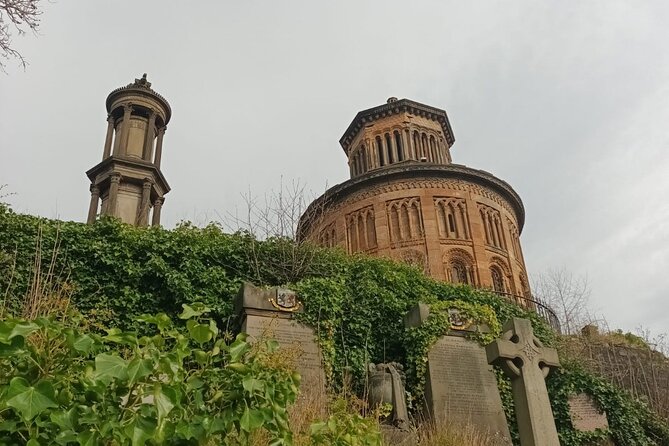
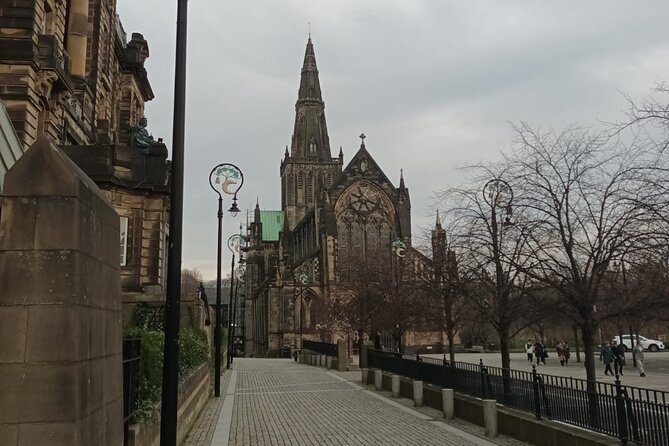
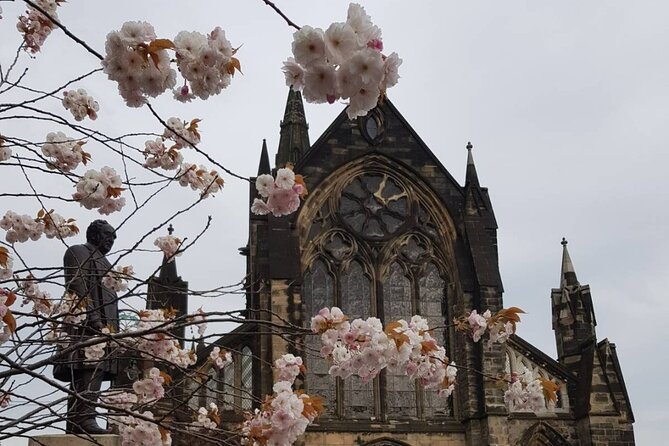
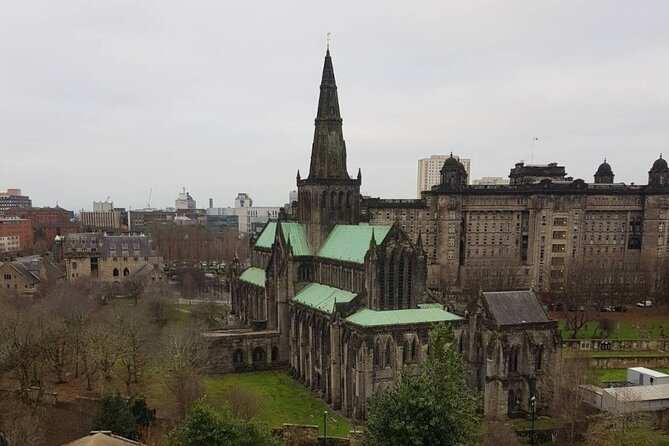
The tour begins at Glasgow Cathedral on Castle Street. That is a strong starting point because the building gives you an immediate sense of the city’s age, faith, and power before the route moves into commercial Glasgow.
The cathedral you see dates from 1197. An earlier building was begun in 1136 but was destroyed by fire soon after. The present cathedral has never been without a roof since its construction, and worship has continued within its walls for more than eight centuries. The audio commentary is designed to explain the building and its setting, so take your time rather than treating this as a quick photo stop.
The cathedral is listed with free admission, but the general terms say entrance fees for attractions are not included. I would check the current opening arrangements before making the cathedral the only reason for your visit.
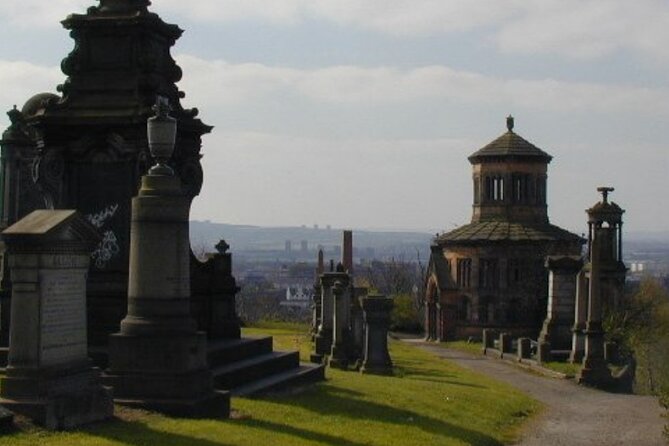
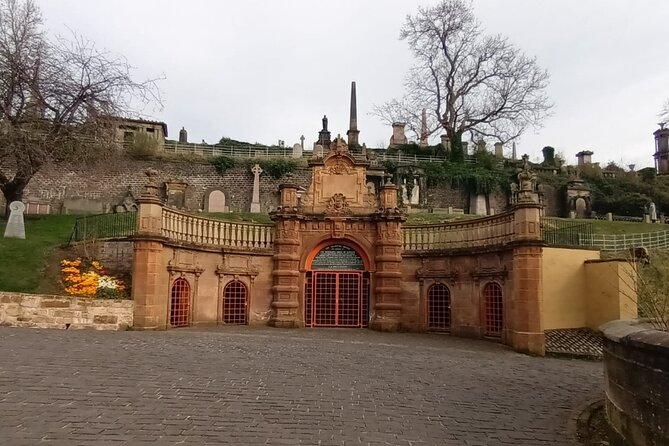
From there, the route reaches the Glasgow Necropolis. This is not a small churchyard tucked behind a parish church. It covers about 37 acres, roughly the size of 15 soccer fields or 150,000 square metres. Established in 1831 and inspired by Père Lachaise in Paris, it was created during a period when wealthy Glaswegians wanted impressive memorials for themselves and their families.
The Necropolis is one of the most rewarding parts of the route because it connects architecture, social history, and views over the city. The scheduled stop is only 15 minutes, but that feels brief for a cemetery of this size. You can follow the audio at the suggested pace, then return later during your three-week access period if you want more time.
More self-guided routes:
- Glasgow Ghost Hunt: The Soul That Got Away Exploration Game
★ 4.0 · 71 reviews - Cycle To Loch Ness – Self Guided
★ 5.0 · 119 reviews - Harry Potter’s Edinburgh: A Self-Guided Audio Tour
★ 4.5 · 42 reviews
Provand’s Lordship and Glasgow’s medieval thread
The route continues toward Provand’s Lordship, a stone building also known as the Hospital of St Nicholas. Its later name came into use in the nineteenth century, while the structure itself reaches back much further.
This stop helps prevent the tour from becoming a simple parade of famous monuments. You get a sense of how Glasgow’s buildings changed names and functions as the city grew. The attraction is particularly useful for anyone who wants context for the cathedral area, where old religious buildings, civic offices, and later commercial streets sit close together.
The route then turns toward murals and the University of Strathclyde. Strathclyde is one of Glasgow’s three major universities, and its buildings provide a different setting from the cathedral and cemetery. The stop includes architecture and several murals, making it a good point to see how contemporary Glasgow uses public art to reshape ordinary walls.
I like this change of mood. Glasgow does not hide its rougher or more practical surfaces behind polished tourist decoration. Murals were created to revive neglected walls and gable ends, while also changing public attitudes toward street art. The route treats them as part of the city’s culture, not as decoration added after the fact.
St. Mungo, old offices, and the Tron Theatre
One of the short stops is the St. Enoch cradling St. Mungo mural. It shows a mother holding a baby, presented as a futuristic image of St. Mungo. The artwork links modern public art with the religious figures tied to Glasgow’s beginnings.
The tour also points out a stone building whose first official record dates to 1626. It served at different times as the Town Clerk’s office, the Justice Court, the Town Council, and, at the top, a jail. That detail gives you a practical way to read old buildings. Instead of asking only who designed them, you begin asking how the city used them over the centuries.
Next comes the tower of the former Tron church, now the Tron Theatre. The street is Trongate, a name connected to Saint Thenew’s Gait and the supposed burial place of Thenew, now more commonly called Saint Enoch. Since Saint Enoch was the mother of Saint Mungo, the stop circles back to the religious stories introduced earlier.
This is the sort of connection that makes an audio route useful. You do not need to build the links yourself from a guidebook map. The narration ties names, streets, saints, and buildings together as you walk.
Police history and the Fellow Residents mural
The route includes Glasgow’s police museum, which covers the city’s police force from 1800 to 1975. Glasgow had the first police force in Great Britain, so this is a worthwhile detail for anyone interested in how a growing industrial city dealt with order, crime, and public life.
The museum is presented as a point of interest on the route, not as an included admission. If you want to go inside, check its current opening hours and any entry requirements separately. The self-guided tour gives you the background, but it does not replace a museum visit.
Nearby, you encounter Smug’s Fellow Residents of Glasgow mural. It shows a hiker gathering mushrooms in woodland, with animals appearing through what look like holes in the wall. The animals are found in Glasgow’s parks and green spaces, giving the artwork a local focus rather than making it a generic fantasy scene.
This is one of the tour’s most praised features. The route does not treat street art as a quick photo opportunity. The audio explains the images and their connection to the city, which adds value if you would otherwise walk past without noticing the details.
A few more trips and experiences worth a look
- Guided Celtic Park Stadium Tour
★ 5.0 · 3,136 reviews - City Sightseeing Glasgow Hop-On Hop-Off Bus Tour
★ 4.5 · 1,873 reviews - Oban, Glencoe, Highlands Lochs & Castles Small Group Day Tour from Glasgow
★ 5.0 · 1,432 reviews - Glasgow City Centre Walking Tour with Local Guide
★ 5.0 · 1,326 reviews
Merchant City, Ramshorn, and Mercury
Stop 5 is at 98 Ingram Street, where you find a church built in 1824 in the Gothic Revival style. English architect Thomas Rickman designed it to replace an older building. The adjoining graveyard includes the tombs of tobacco merchants Andrew Buchanan and John Glassford.
The cemetery also connects with the older Ramshorn burial ground. Part of that earlier site is now covered by Ingram Street, and in the eighteenth century it was an expensive and fashionable place to be buried. Later, the Necropolis took over that role. You can see how burial customs followed the city’s wealth and changing geography.
A statue of Mercury follows. The Roman god represented financial gain, commerce, eloquence, poetry, travellers, boundaries, luck, trickery, and thieves. The sculpture sits on a marble plinth and is one of two Mercury statues made by Alexander Sandy Stoddart. Here, the art fits the Merchant City setting, an area shaped by trade and money.
Then the route reaches Glasgow City Chambers and George Square. The City Chambers were completed in 1888 and opened by Queen Victoria. A statue of Victoria stands at the opposite end of George Square. The square itself was named for King George III and was first laid out in 1781 as part of a planned Georgian grid, although development took another 20 years.
These stops are useful because they explain Glasgow as a commercial city. The cathedral tells one story, the Necropolis tells another, and Ingram Street, the City Chambers, and George Square show how civic pride and trade shaped the centre.
Glasgow icons, the Gallery, and Mackintosh-style tea
The narration also points out one of Glasgow’s unusual emblems and explains the city’s sense of humour around it. The supplied information does not name the emblem, so you will need to listen for the explanation rather than rely on a written summary. That is a good reminder to keep your phone charged and your audio working.
Another stop is described as a must-see city gallery. The exact name is not given in the tour details, so treat this as a point to identify in the app. The route also mentions The Lighthouse, a visitor centre, exhibition space, and event venue in central Glasgow.
You pass a tea room established in 1983. Its interior draws on the work of Charles Rennie Mackintosh, and the room is modelled on Kate Cranston’s Ingram Street tea rooms from the early 1900s. Alex explains the origin of these tea rooms, giving you a pleasant cultural pause between civic monuments and shopping streets.
I like this part because it brings Glasgow’s design tradition into the walk without turning the whole experience into an architecture lecture. Mackintosh is one of the city’s key artistic figures, and a tea room is a more human way to encounter that influence than simply reading dates on a plaque.
Buchanan Street and the final murals
Buchanan Street marks the route’s move into present-day Glasgow. By this point, you have passed from the cathedral and medieval religious stories through tobacco wealth, civic buildings, murals, and the city’s more recent identity.
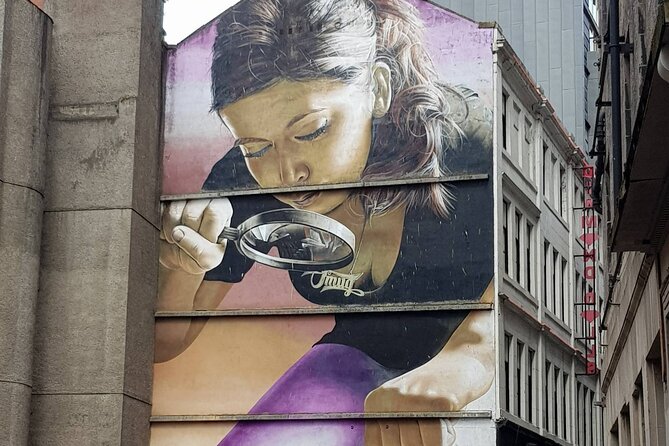
The route’s final Smug mural is Honey, I shrunk the Kids, described as photo-realistic street art. It gives you one last example of how Glasgow has used large-scale murals to make ordinary city walls part of the public experience.
The walk finishes close to St. Enoch Subway Station, near the Roman Fort. This is a practical ending. You are not left in an isolated spot, and you can continue around the centre or use public transport. The final location also gives the route a sense of returning to Glasgow’s older foundations after showing you its modern streets.
The planned time is two to three hours. That estimate works if you keep moving and listen at each stop. It does not include long museum visits, extended time in the cathedral or Necropolis, meals, shopping, or frequent photo stops. One person took about five hours by stopping for lunch, drinks, and points of interest, which is exactly how I would use the tour.
What the app does well, and where it may frustrate you
The Pandemic Tours app supplies a map, route, GPS guidance, stop information, photos, videos, recommendations, and an audio guide voiced by Alex. You receive three weeks of unlimited access, so you can split the walk over more than one day or repeat a section.
That access period is a real advantage. You can make the first outing a quick orientation, then return to the Necropolis, cathedral area, or murals when you have more time. You also avoid the fixed schedule and group pace of a conventional walking tour.
The weakness is operation. You must download the app after booking and activate it using the instructions sent by email. The booking reference is not the activation code, so read those instructions carefully.
The narration may not start automatically at every stop. You may need to switch between the app and the map, and the app can lose its place when you leave it. Some users also found the voice too quiet or the recording quality below par. Use headphones, keep the volume checked before setting off, and save the route details before you begin.
The app is not a live guide. No person will meet you at Glasgow Cathedral, and no guide will walk beside you. That distinction matters. If you want conversation, spontaneous questions, or someone to handle directions, choose a guided walk instead.
Who gets the best value at $12.37
At $12.37 per person, the price is low for a private activity because only your group participates. You are paying for a prepared route and three weeks of access, not transport, personal guiding, or admission to attractions.
I think the value is strongest in three situations:
- You have limited time and want a planned route through several parts of central Glasgow.
- You prefer to stop when something catches your eye.
- You enjoy mixing traditional history with modern murals and design.
Solo visitors can use it especially well because there is no need to coordinate with a group. Couples and families can also set their own pace, though the app may be less convenient when one person is trying to navigate while others are listening.
The value is weaker if you dislike phone-based tours or expect a guide to appear at the meeting point. It is also less useful if you want to spend most of your time inside museums and historic buildings, since the route mainly takes you to their locations and provides commentary.
The overall rating is 4.2 from 21 ratings, with especially strong praise for the cathedral, murals, clear explanations, and flexible pace. The lower scores focus on app handling, narration volume, and confusion about the lack of a physical guide. Those are not small details, so match the product to your expectations.
Practical advice for making the walk work
Start with a fully charged phone and download the Pandemic Tours app before reaching Castle Street. Confirm that you can hear Alex clearly, and keep the map available even when the narration is playing.
Wear shoes suited to a city walk. The route includes the Necropolis, which covers a large area, and the total time can grow quickly once you stop for photographs or refreshments. The published 15-minute Necropolis stop is more of a suggested pause than a limit.
Plan your day around the route rather than forcing every stop into a strict two-hour schedule. The audio sections at some points are only five or ten minutes, but the surrounding streets and buildings deserve a slower look.
The tour is offered in English. Service animals are allowed, the route is near public transportation, and most people can participate. Entrance charges, if any apply at the attractions you choose to enter, are not included.
Because the experience is non-refundable and cannot be changed after booking, be sure you want a self-guided format before paying. The product is simple to use when you understand that you are buying app access, not a meeting with a local guide.
Should you book this Glasgow walking tour?
I would book it if you want a low-cost introduction that joins medieval Glasgow, Merchant City, civic landmarks, and public art in one walk. The content appears strongest when it connects places that are easy to see but harder to understand on your own, especially the cathedral, Necropolis, old burial grounds, saints, and murals.
I would skip it if you need a fully managed experience. The app can require too much map checking, the audio may be quiet, and there is no live guide to solve problems on the spot. For independent visitors who accept those limits, $12.37 buys a useful route and three weeks of access. For anyone expecting a person at the cathedral, it will be the wrong product.
FAQ
Is this a live guided walking tour?
No. It is a private self-guided activity for your group, with audio narration in the app. No live guide is included.
Where does the tour start?
It starts at Glasgow Cathedral, Castle Street, Glasgow G4 0QZ, United Kingdom.
Where does the tour finish?
It finishes at St. Enoch Subway Station in Glasgow, near the Roman Fort.
How long does the tour take?
The expected duration is about two to three hours. You can take longer if you stop for meals, drinks, museums, photographs, or extra time at the Necropolis.
What language is available?
The tour is offered in English.
What do I need to use the tour?
You must download the Pandemic Tours app after booking. You will receive an email with instructions to activate the tour. The booking reference is not the activation code.
Are entrance fees included?
No. Any entrance fee for attractions mentioned during the tour is not included.
Can I cancel or change the booking?
No. The experience is non-refundable and cannot be changed for any reason.
Just added around Glasgow
- Glasgow: Glencoe & Oban Privately Guided Day Tour in Luxury MPV★ 5.0 · 3 reviews
- Highland Lochs & Castles Tour to Oban & Glencoe★ 5.0 · 3 reviews
- Jacobites and Scottish Highlands Day Tour from Glasgow★ 4.5 · 3 reviews
- Pints & Past: Glasgow Pub Tour Private Tour★ 5.0 · 3 reviews
- 3 Day Isle of Skye Eilean Donan Castle and Loch Ness Tour★ 5.0 · 3 reviews
- The Scottish Highlands Photography Tour & Workshop★ 5.0 · 3 reviews
- Scottish Highland Day Tour from Glasgow★ 5.0 · 3 reviews
- Whisky Adventure – Private Day Tour from Glasgow★ 5.0 · 3 reviews
Self-Guided Tours, compared.
Glasgow Ghost Hunt: The Soul That Got Away Exploration Game
Read our review →
Harry Potter’s Edinburgh: A Self-Guided Audio Tour
Read our review →

500 Years of Crime and Punishment: A Self-Guided Audio Tour
Read our review →
Ghosts of Edinburgh: Bloody Past Exploration Game and Tour
Read our review →
The Dark Side of Aberdeen: A Self-guided Audio Walk
Read our review →
Browse the lists this tour appears in